Part 1: I Asked Pat Riley How to Sustain Excellence. Here’s What He Said.
Author: Desiree Whitehead
There are moments where you sit back and observe.
And then there are moments where you step in.
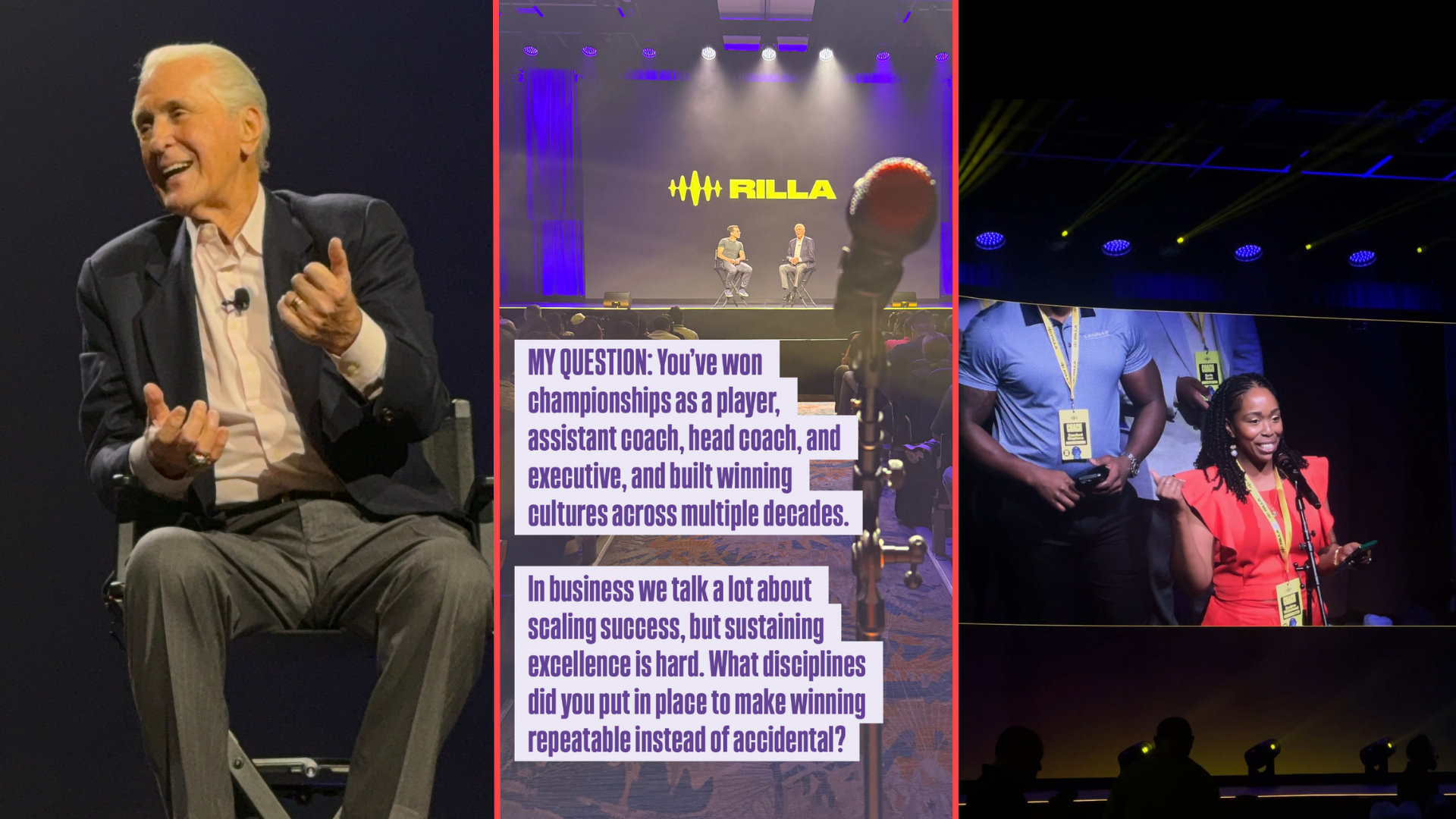
At the RILA Masters Conference, when the floor opened for questions, I didn’t hesitate. I got up and went straight to the mic.
Because this wasn’t just any keynote.
This was Pat Riley.
As a South Florida native, sitting in that room carried weight. Not just because of what he’s accomplished, but because of what he represents. Longevity. Discipline. Standards that don’t bend.
So I asked the question we talk about all the time in business:
How do you not just win, but sustain excellence?
Because scaling is one thing. But staying great over time is something very few people figure out.
It Starts With a Role You Don’t Want
Before championships, before leadership, before legacy, Riley started with something most people would walk away from.
He shared a moment early in his career where he was given an opportunity to stay in the league, but only under one condition. He would not play. He would not get minutes. His role would be to show up every day and push the starters in practice.
“You won’t play. You’re never going to play… are you willing to be a practice player?” – Pat Riley
No spotlight. No guarantees. Just work.
And he said yes.
What stood out wasn’t just the decision. It was how he approached it. He described going at Hall of Fame players relentlessly in practice, treating every rep like it mattered, even when no one was watching.
Over time, that effort changed how he was seen. Coaches took notice. Players responded. And eventually, he earned his way into the rotation.
That moment reframes how most people think about opportunity.
We tend to wait for the right role. The visible role. The validating role.
But growth usually starts in a role that doesn’t look like growth at all.
If It’s Not Talent, It Has to Be Effort
Riley was direct about something many leaders avoid saying out loud.
He knew he wasn’t the most talented player on the court.
So he made a decision early. If talent wasn’t going to separate him, effort would.
He shared how a coach told him that the only way he would make the team was by becoming the best conditioned athlete in camp. Not one of the best. The best.
“You’ve got to be the best conditioned athlete, the most prepared athlete.” – Pat Riley
That meant winning every sprint, every conditioning drill, every test of endurance.
He trained relentlessly to earn his place, not expect one.
What makes this powerful is the shift in mindset. Instead of focusing on what he lacked, he focused on what he could control. And over time, that mindset didn’t just shape his career as a player. It became foundational to how he built teams.
Because when you remove the excuse of talent, what you’re left with is effort.
And effort is always available.
The Standard He Built Was Not About Comfort
When Riley transitioned into coaching, his philosophy didn’t change. It expanded.
He wasn’t trying to build a team that looked good. He was trying to build a team that could win consistently, under pressure, over time.
He described the kind of team he wanted in very specific terms:
“The hardest working, best conditioned, most professional, unselfish, toughest, nastiest team in the league.” – Pat Riley
And he made it clear that being liked was not part of the goal.
That distinction matters.
Because in a lot of organizations, decisions get softened to maintain comfort or avoid tension. Standards get adjusted to accommodate people instead of being upheld to develop them.
Riley built around standards, not comfort.
And that is what made the difference.
How They Won: Small Improvements That Compounded
One of the most practical frameworks he shared came from how he approached performance as a coach.
After evaluating his team, he identified key categories that directly impacted winning. Instead of asking players to completely transform their game, he focused on incremental improvement.
“If you can improve just 1 percent… you could get an overall team efficiency of 60 percent.” – Pat Riley
At first, that sounds small.
But when you apply that across multiple categories and an entire team, the impact compounds quickly.
The focus areas included things like rebounding, defensive effort, and transition control. Players tracked their performance, saw their progress, and understood how their effort contributed to the outcome.
This wasn’t about motivation.
It was about structure.
And that structure turned into results.
The Moment Success Becomes Dangerous
Right after talking about winning, Riley addressed something that often gets ignored.
What happens after you succeed?
He described complacency as something that shows up immediately, not eventually.
“We all have this little thing sitting on our shoulder called complacency.” – Pat Riley
That line reframes the challenge entirely.
Most teams think the hardest part is getting to the top.
But staying there requires a different level of awareness. Because the moment you win, there is a natural shift. Effort softens. Urgency fades. Standards loosen, even if only slightly.
And that is enough to lose.
This is where systems matter most.
Because when motivation changes, structure is what keeps performance consistent.
What Competition Actually Requires
One of the most memorable parts of his talk came from a story about competing against Michael Jordan.
Riley described preparing his team to face elite talent and made it very clear what that requires mentally.
“When you run into people like Michael Jordan… you’ve got to meet them at the rim.” – Pat Riley
That image is intentional.
It means you do not step aside. You do not avoid the moment. You step directly into it, knowing it will be difficult.
In business, this translates directly.
There will always be competitors who are stronger, faster, or further ahead. The instinct is often to adjust expectations or play it safe.
But capability is built in the moments where you choose to engage anyway.
Not when you avoid it.
Where This Leaves Us
What stood out most from this session wasn’t a single tactic or takeaway.
It was the consistency of the mindset behind everything Riley shared.
Success, in his world, is not built on moments. It is built on standards, effort, and systems that hold over time.
It shows up in how you approach the role no one wants. It shows up in how you train when no one is watching. And it shows up in how you respond after you’ve already won.
Because that is where the real work begins.
What’s Coming in Part 2
In Part 2, I’ll break down the second half of his message, including:
The difference between rules and what he calls a “covenant”
How he balances data with intuition as a leader
What actually makes excellence repeatable
The role of trust and continuity in building long-term success
And most importantly, how all of this applies directly to building and scaling a business.