Part 2: Pat Riley Says Sustaining Excellence Isn’t a Feeling. It’s a System.
Author: Desiree Whitehead
In Part 1, we talked about how Pat Riley built the foundation.
Effort over talent. Standards over comfort. Systems over motivation.
But the question I asked him wasn’t just about how to win.
It was about how to keep winning.
Because that is where most teams fall apart.
The Question: How Do You Make Winning Repeatable?
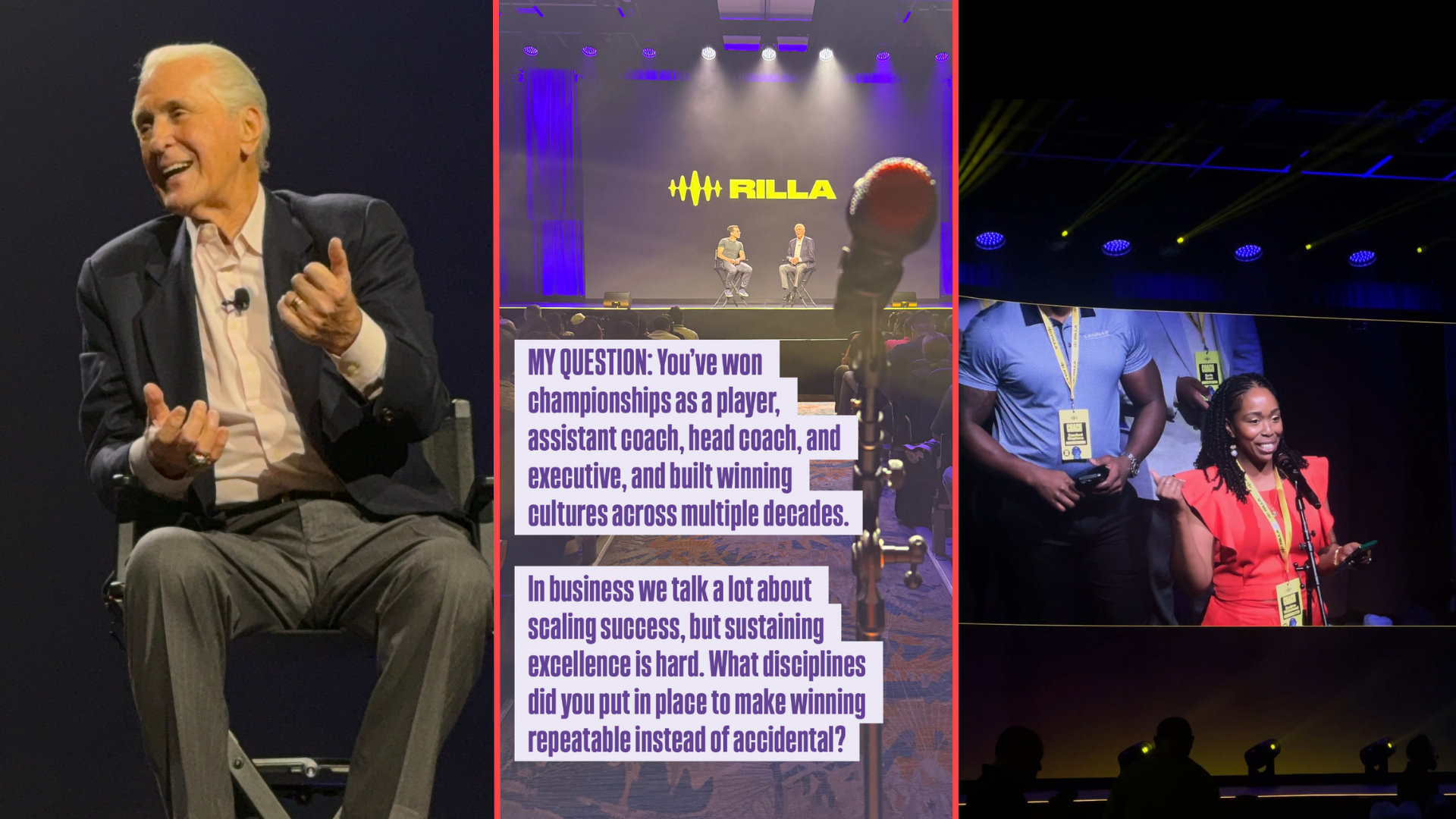
When I got to the mic, I asked him directly:
How do you not just scale success, but sustain it? What systems and disciplines actually make winning repeatable?
His answer was structured, but not complicated.
It starts with clarity.
“You have to develop your philosophy or your mission. You have to know what it is you want to do.” – Pat Riley
From there, everything builds.
You create systems that support that mission. You measure whether those systems are producing results. And if they are not, you adjust.
“If you’re not getting the result, then you have to pivot quickly and reset whatever that plan or system is.” – Pat Riley
That word matters.
Pivot.
Not protect the system. Not defend the plan.
Adjust it.
Because the goal is not to preserve what you built.
The goal is to produce results consistently.
Why Most Teams Struggle to Sustain Success
One of the most important distinctions Riley made is that excellence is not static.
It is not something you reach and hold.
It is something you continue to push.
“In order to excel, it means to go above and beyond.” – Pat Riley
And the problem is that most teams stop at great.
They hit a milestone, see results, and shift into maintenance mode.
But excellence requires something different.
It requires a mindset that refuses to settle.
Even when things are working.
Culture Is Not Rules. It’s a Covenant
This was one of the most powerful reframes from the entire session.
Riley said he avoids the word “rules” entirely when building teams.
Instead, he introduced the idea of a covenant.
“I didn’t like to use the word rules… we came up with the term covenant.” – Pat Riley
A covenant is not forced.
It is agreed upon.
It is a shared understanding between the team and leadership around:
How we operate
What we expect
What we are working toward
That distinction changes everything.
Rules create compliance.
But compliance does not sustain excellence.
Commitment does.
And commitment only happens when people buy in.
Data Can Support You. It Cannot Lead You
In a room full of operators and leaders, Riley addressed something that is becoming more relevant across every industry.
The role of data.
He acknowledged how far analytics have come, but he also made a clear distinction.
“You can get so caught up in the numbers that you miss the most important thing… intuition.” – Pat Riley
He used data to motivate players.
To show effort. To highlight gaps. To reinforce standards.
But he did not rely on it to make every decision.
Because leadership requires something data cannot replicate.
Judgment.
Timing.
Awareness of people and context.
Data gives you information.
But leaders still have to decide what to do with it.
What Actually Builds Dynasties
Toward the end of the session, Riley was asked what separates teams that win once from those that sustain success over time.
His answer was immediate.
Continuity.
“Continuity… to me, that’s one of the most important things that a leader can do.” – Pat Riley
Continuity in leadership. Continuity in people. Continuity in vision.
He contrasted that with environments where leadership constantly changes, priorities shift, and teams are rebuilt over and over again.
It becomes difficult to sustain anything in that kind of environment.
But continuity alone is not enough.
It has to be paired with trust.
“If your people don’t trust you, then you’re probably not going to win.” – Pat Riley
And trust is not built through words.
It is built through:
Consistency
Competence
Showing up over time
Without that, systems break down.
And without systems, excellence cannot hold.
Leadership Evolves, But the Principles Stay the Same
One of the more subtle, but important parts of his talk was how he described moving from player to coach to executive.
At each level, his role changed.
But his approach did not.
As a player, he learned how to contribute.
As a coach, he learned how to develop others.
As an executive, he focused on building the right systems and surrounding himself with the right people.
He emphasized something that applies directly to leadership in business.
You cannot do everything yourself.
You have to trust the people you put in place.
“Hire the best people… and let them do their job.” – Pat Riley
That shift is what allows organizations to scale.
Not more control.
Better structure.
The Throughline: Effort, Standards, and Alignment
When you step back and look at everything Riley shared across both parts of his talk, a pattern becomes clear.
Sustained excellence is not built on one thing.
It is built on alignment across multiple layers.
Individual effort
Team standards
Organizational systems
Leadership clarity
And when those things are aligned, performance becomes repeatable.
Not because it is easy.
But because it is intentional.
This Was Never About Basketball
The biggest takeaway from this session was not about basketball.
It was about how organizations operate when they are built to last.
Winning once is exciting.
But building something that continues to perform, even as conditions change, even as pressure increases, even as expectations rise, that requires a different level of discipline.
It requires systems.
It requires standards.
And most of all, it requires leadership that is willing to evolve without lowering the bar.
This Is Where Most Teams Break Down
Most teams don’t struggle because they lack ideas. They struggle because their standards aren’t clearly defined, their systems aren’t consistently followed, and execution depends too much on momentum instead of structure.
That’s the gap. And it’s the difference between building something that works once and something that actually holds over time.
If you’re in a season where growth feels inconsistent, or you’re trying to scale without losing what’s already working, this is usually where we start.