Most founders treat RevOps like a project. Something to schedule once things settle down.
I think of it more like interest.
Every month you run your revenue on spreadsheets and memory, you’re paying it. You just never see one big bill. The charges show up in small amounts all over your pipeline: a lead that waited three days for a reply, a forecast built on a hunch, a deal that stalled because nobody owned the handoff, a new hire who spends her first month decoding someone else’s notes.
And I get why it keeps sliding. When you’re the one closing deals, answering support emails, approving payroll, and fixing the website at midnight, a CRM project feels like a luxury you’ll get to later.
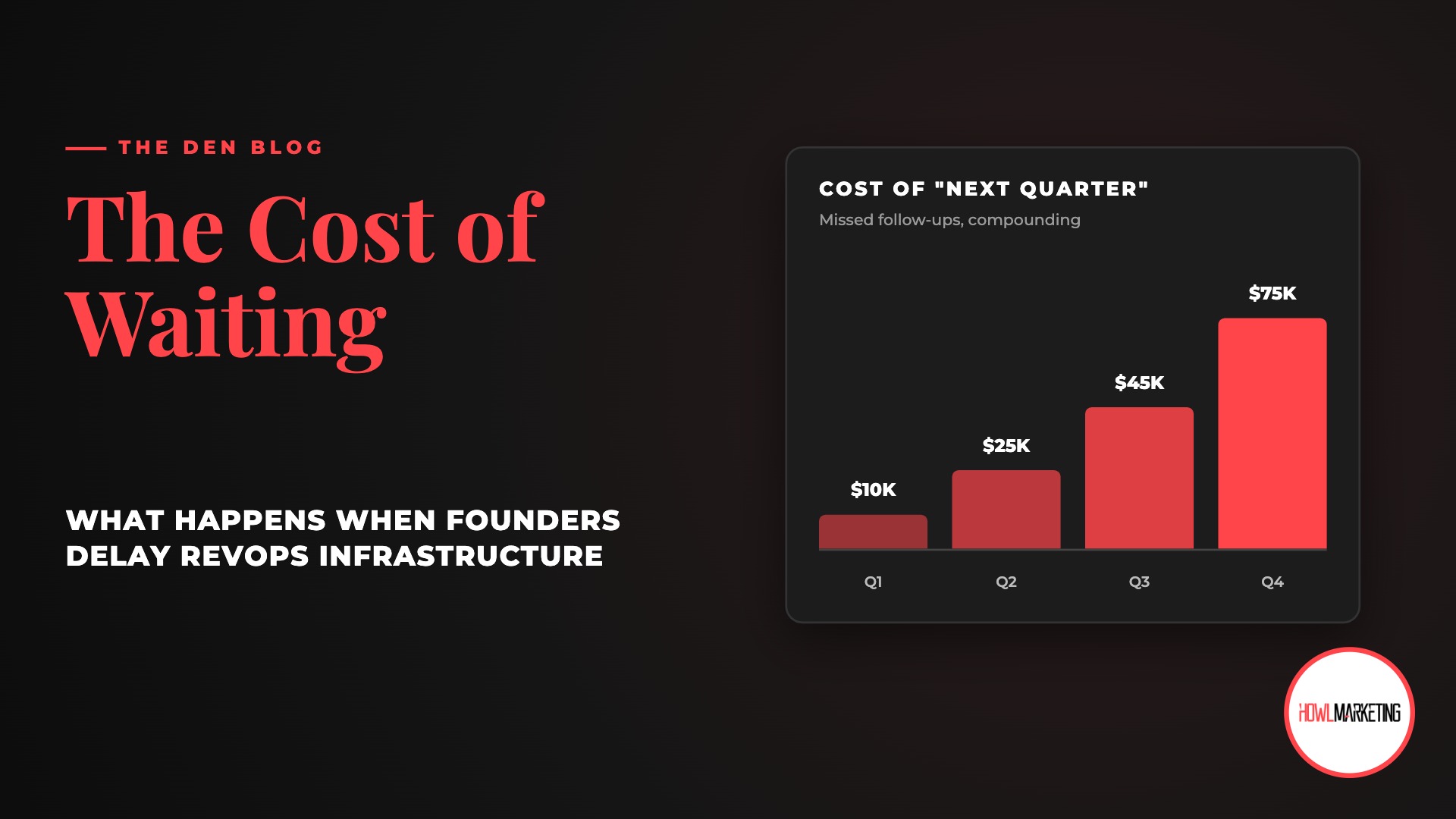
Here’s what more than two decades in growth work has taught me. “Later” rarely shows up on its own. And the cost of waiting doesn’t stay flat.
It compounds.
Why “next quarter” feels like the safe call
Waiting feels free. No new software bill, no implementation project eating up a week of your team’s time. The spreadsheet works well enough, and revenue is still coming in.
That’s the trap. Revenue operations (the systems, data, and handoffs that connect your marketing and sales to the revenue they produce) rarely breaks loudly. It leaks quietly. You don’t get an alert when a lead goes cold. Nobody sends you an invoice for the decision you made on a hunch.
So the status quo looks cheap. It just sends the bill somewhere you aren’t looking.
Where the cost actually shows up
When I look under the hood at a company that has put off RevOps infrastructure, I see the same five costs stacking on top of each other.
1. Leads that go quiet
Someone fills out your form on a Friday. It lands in a shared inbox. Monday gets busy. By Wednesday they’ve booked a call with someone else. Without a system that routes and reminds, follow-up depends on whoever happens to remember, and memory is not a process.
2. Decisions made on gut
Ask a founder without clean pipeline data which channel brings in their best customers and you’ll usually get a confident answer. Then we pull the data together and, more often than you’d think, it’s a different channel entirely. Every month you wait is another month of spending against a guess.
3. Workarounds become the system
Your team is smart. If there’s no system, they’ll build one: personal spreadsheets, sticky notes, a notes app, a Slack channel that’s secretly the pipeline. Those habits harden. The longer they run, the harder they are to replace.
4. Every new hire inherits the mess
This one gets me fired up. Founders hire a salesperson to grow faster, then hand them a pipeline nobody can read. If I had to choose between hiring another salesperson or fixing the pipeline they’ll walk into, I’m fixing the pipeline every single time.
5. The history you never captured
You can buy software any day of the week. You can’t buy back the year of customer data you didn’t track. Every quarter you wait is a quarter of conversion rates and deal-cycle history that simply won’t exist when you finally sit down to forecast.
What waiting looks like on paper
Let’s put rough math on it. These are round, illustrative numbers, not a client’s results, so swap in your own.
Say you bring in 100 leads a month and 10 of them slip through without real follow-up. If one in five of those would have closed at $5,000, that’s $10,000 a month walking out the door. Six months of “next quarter” puts you at $60,000.
Now add the time. Five hours a week reconciling spreadsheets and chasing status updates comes to roughly 130 hours over those same six months. That’s more than three full work weeks of someone’s attention.
And the cleanup grows while you wait. Moving 500 messy contacts into a CRM is an afternoon. Moving 15,000 with duplicate records and three spellings of the same company is a project.
You don’t have to build it all at once
The good news? Fixing this doesn’t mean pausing the business for a quarter-long overhaul.
At Howl, we live by “clarity before execution.” Before anyone touches a tool, we get clear on how a lead moves from first touch to closed deal, and who owns each handoff along the way. Once that’s written down, the build goes faster and the team actually uses it.
From there, start small:
- Pick one source of truth for contacts and deals, and retire the side spreadsheets.
- Define your lifecycle stages so marketing and sales use the same words.
- Set up automatic routing and follow-up reminders for every new inquiry.
- Build one dashboard you’ll actually look at every Monday.
That’s a foundation you can grow into, and it starts paying you back the week it goes live.
Stop paying the interest
If you’ve been telling yourself “next quarter” for a while now, I want you to hear this. You’re probably closer than you think. You already know how your best deals happen. A system just turns that knowledge into something your whole team can use, today and five hires from now.
The best time to build it was a year ago. The next best time is before “next quarter” quietly turns into next year.
If you want a second set of eyes on where your revenue might be leaking, the team at Howl Marketing would love to help you map it out. You’ve got this. Let’s figure it out.